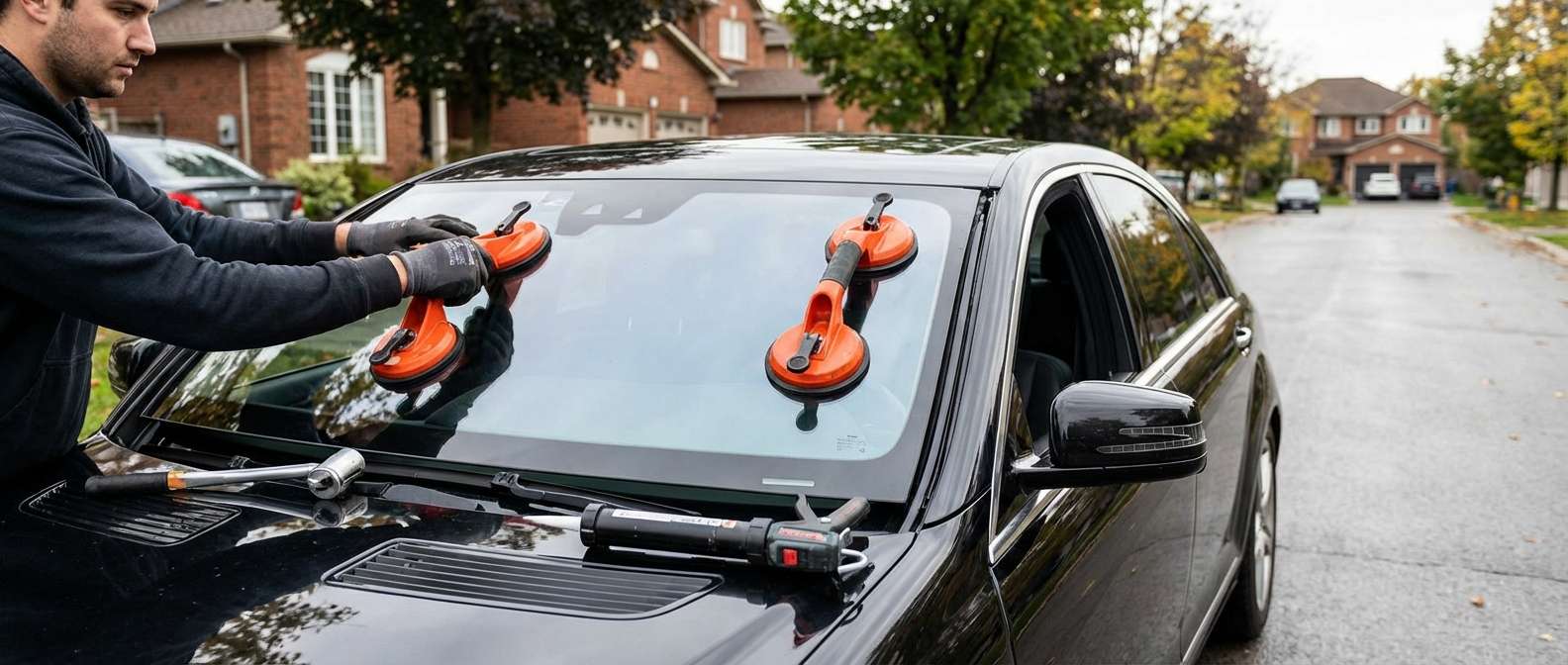
Infrared Solar Coatings and Camera Optical Cutouts
The distinctive purplish-red sheen across the front of your Mercedes-Benz S-Class comes from a factory climate comfort laminate designed to block infrared heat. Because this metallic thermal layer deflects electromagnetic and heat waves, standard transponders and radar detectors cannot communicate through the main surface. Mercedes engineered clear radio frequency pass-through zones flanking the rearview mirror housing and near the lower corners of the glass to keep garage openers and toll tags functioning.
Selecting the correct replacement glass requires matching the camera hardware mounted against the inside of the windshield. Cars optioned with Night View Assist (Code 610) require a dedicated uncoated optical window in the infrared barrier directly ahead of the active night vision camera lens. Standard aftermarket glass lacking this specific window will completely blind the near-infrared camera, returning a milky or washed-out image on the instrument cluster display.
| Glass Configuration | Mercedes Dealer Part | NAGS Reference | Hardware Distinctions |
|---|---|---|---|
| Thermal Acoustic IR (Base) | A2216702601 | FW02676 | Rain/light sensor bracket, RF pass-through slots |
| Thermal IR + Night View Assist | A2216700201 / A2216709401 | FW02677 | Optical IR camera cutout, multifunction camera shroud |
On 2010 to 2013 facelifted models, the bracket assembly expands further to house the multifunction forward-facing cameras governing Lane Keeping Assist and Speed Limit Assist alongside the rain/light sensor (RLS). I source strictly aftermarket glass manufactured by brands such as Pilkington, PGW, FYG, and XYG, verifying that the optical clear zones match your specific factory driver-assist options so every sensor sees cleanly through the laminate.
Water Management, Cowl Drains, and Pillar Trim Integrity
The bottom edge of the windshield interfaces with a two-piece plastic cowl panel that covers the twin-pivot, opposed-sweep wiper linkage. Beneath this water deflector sit crucial body drainage paths. When tree needles and road grit block the lower cowl drain tubes, water backs up directly over the cabin air intake housing. This creates a severe failure path into the passenger footwell, routinely flooding the front Signal Acquisition Module (SAM) and destroying sensitive vehicle electronics.
- Rain and Light Sensor Gel Coupling: The combination RLS bracket bonded behind the rear-view mirror requires a fresh, bubble-free optical gel pad. Reusing a dried or distorted silicone pad causes erratic wiper activation during light drizzle and intermittent headlight switching in broad daylight.
- A-Pillar Water Deflector Mouldings: Structural snap-in mouldings line the outer edge of both windshield pillars to funnel water over the roofline rather than into the side windows. Damaged retention clips or improper vertical spacing leave gaps that generate harsh aerodynamic whistling at highway speeds.
- Wiper Arm Fluid Lines: The opposed-sweep wiper system integrates pressurized fluid delivery nozzles directly along the articulated wiper arms, requiring careful detachment from the cowl supply lines during glass service to avoid fracturing the plastic fittings.
Preserving the factory acoustic quietness inside the W221 cabin depends on setting the glass to the exact original deck height against the steel and aluminum unibody aperture. Even a two-millimeter height discrepancy disrupts the flush transition between the roof panel, windshield perimeter, and side deflector strips, transforming an otherwise silent cabin into a source of wind noise.





