Ground-Level Exposure and Glass Abrasion on the Roadster
Sitting merely inches off the pavement with an aggressively raked front nose, the front glass on this sports car acts like a deflector shield for highway grit, kicked-up gravel, and tire debris. While conventional hatchbacks take stone impacts squarely on their plastic grilles or vertical bumper covers, this vehicle funnels airborne debris directly into the laminated glass. As a result, heavy pitting, star chips, and rapid sandblasting across the driver line of sight happen far sooner than on taller vehicles, quickly compromising nighttime forward visibility.
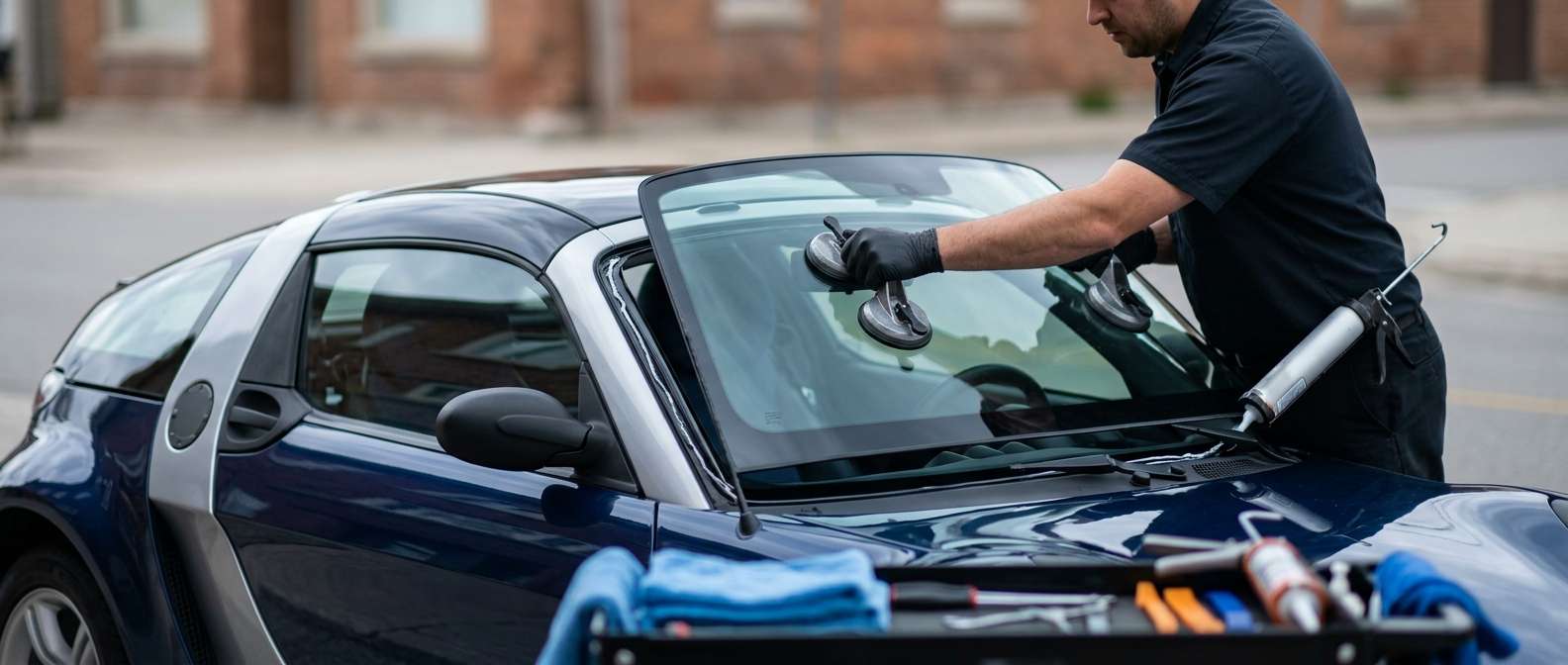
Because the car is exceptionally compact and specialized, I operate on a purely mobile basis across Toronto and the surrounding GTA, replacing damaged glass directly in your residential driveway or at your workplace parking spot. When chips turn into running structural cracks across the windshield face, replacing the panel requires sourcing the proper green-tinted solar safety glass, cross-referenced under NAGS prefix FW02689 (often listed as FW02689 GTN) or European standard Eurocode 5355. Regardless of whether you drive the notchback W452 roadster or the glassback C452 coupe, both bodies utilize the exact same front windshield dimensions throughout the entire 2003 to 2006 manufacturing run.
Rain Sensor Brackets and Header Rail Interfaces
Selecting the correct aftermarket replacement comes down to how your vehicle was optioned for automatic wiper control. The glass was manufactured in two distinct variants: a standard base version, and an optical setup identified by Eurocode 5355AGSM1B that features a pre-bonded circular bracket. This factory bracket houses a forty-four millimeter round silicone gel pad that transfers light to the internal sensors. Reusing an old sensor ring on bare glass frequently introduces air pockets that cause erratic intermittent wiping, making it critical to align the replacement glass part with the car's original equipment setup.
Above the glass, the top edge aligns precisely against the structural front header rail. This joint must seal seamlessly against the primary mechanical latching zones for either the twin removable hardtop roof panels or the motorized fabric soft-top track. Immediately outboard, frameless side windows slide directly against the rubber A-pillar seals running alongside the perimeter reveal moulding. Because there are no embedded defroster wires or heated wiper park zones built into the glass, the windshield relies entirely on the cabin HVAC defroster vents to clear inner condensation.
Shielding the Bulkhead and the Vulnerable SAM Unit
Below the bottom glass perimeter lies a two-piece plastic scuttle cowl tray that protects the twin opposing wiper linkage and houses the windshield washer nozzles. This lower juncture is a notorious danger zone for water management. Rainwater running down the broad surface of the glass enters the cowl trough, where factory bulkhead seams degrade and small drainage funnels choke with leaf litter. When water fails to shed through the inner fender cavities, it crests the cabin bulkhead wall and drips directly behind the dashboard.
Directly beneath that interior drip line sits the Signal Acquisition and Actuation Module. The SAM unit manages the vehicle's central fusing, body controllers, ignition circuits, and immobilizer electronics. When windshield perimeter integrity fails or water bypasses a neglected scuttle cavity, moisture pools directly inside this electrical fuse board. The resulting corrosion triggers phantom horn activation, dead instrument clusters, wiper motor seizure, and total vehicle immobilization, turning an unaddressed glass seal fault into an electrical disaster.