Integrated Antenna Leads and Rain Sensor Options on 996 Glass
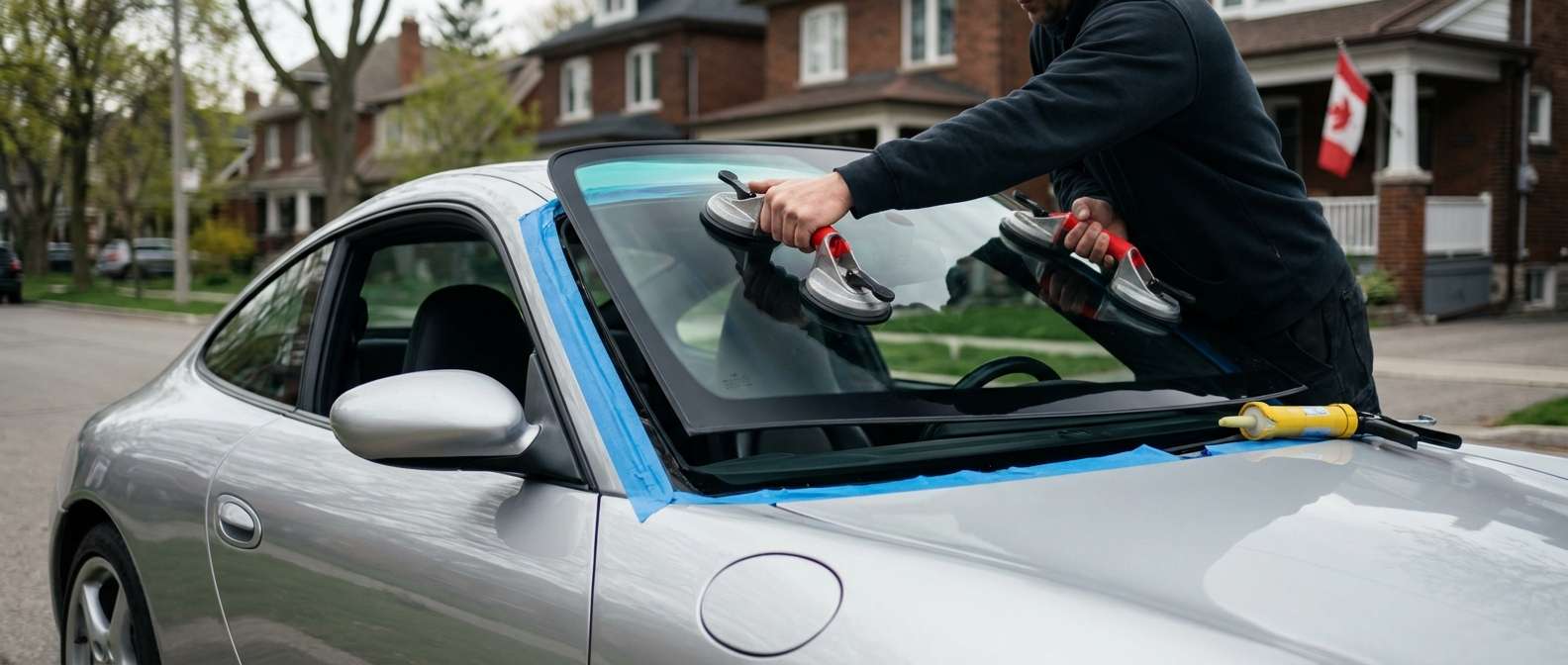
The windshield on this sports car does much more than deflect oncoming air, incorporating delicate electronics that dictate which replacement glass unit your car requires. Embedded directly inside the glass layers is a fine-wire grid serving as the factory AM/FM radio antenna. This antenna connects to external leads routed down through the base of the windshield and behind the passenger-side interior A-pillar trim cover to reach the factory amplifier. Severing these delicate internal ribbons during glass service ruins radio reception, making careful disconnection behind the interior trim essential before the old glass moves an inch.
Pinpointing the correct replacement panel also depends on whether your car left Stuttgart with option code M265. Vehicles with this option carry an integrated optical rain sensor bracket bonded directly behind the interior rearview mirror, whereas base configurations feature a standard metal mounting puck. Glass variants split further between a uniform green tint (originally designated by Porsche part numbers like 996-541-901-11 or 996-541-901-34) and glass featuring a dark upper shade band (reflecting factory references such as 996-541-901-33 and rain-sensor-equipped 996-541-901-41). The rearview mirror itself cannot be pried or pulled outward; it requires a precise rotational twist off the factory-bonded metal mounting button, as prying against the inner laminate risks fracturing the bracket or cracking the glass.
Managing the Two-Piece Perimeter Trim and Cowl Creaks
Unlike modern vehicles that use fully encapsulated modular glass, this windshield relies on a distinct two-piece perimeter sealing assembly. The design utilizes an internal plastic-and-metal C-shaped retainer channel running along the A-pillars and roofline paired with an outer rubber T-shaped reveal moulding, matching parts 996-541-541-02 and 996-541-531-01. Generic universal push-in rubbers never seat properly against the body lines of this car; they inevitably lift at highway speeds and cause aggressive wind noise. I ensure the outer moulding fits completely flush into its channel without pressing down excessively against the edge of the glass, which could induce stress cracks.
Frameless door windows that index downward slightly when the door latch is triggered and seat upward into the body channel put added acoustic demands on the front glass seal. Precision during installation prevents the well-known lower dash squeak that plagues these cabins, where friction develops between the lower glass edge, the instrument panel structure, and the two-piece plastic cowl water deflector. Every replacement I carry out includes a full year of protection against defects in the glass alongside my personal lifetime warranty on the workmanship. Properly setting the glass height keeps the lower edge isolated from the plastic cowl tray and cabin bulkhead, preventing dry plastic rubbing noises over coarse pavement.
Shared Geometry Between Coupe, Cabriolet, and Boxster
Because the front bulkhead and windshield frame architecture are shared directly with the 986-generation Boxster, the windshield geometry remains consistent across the Coupe, Targa, and Cabriolet body styles. Whether working on a narrow-body Carrera, an all-wheel-drive Turbo, or a track-focused GT2, the outer glass profile remains identical, though convertible variants demand extreme caution around the soft-top header seal interface. The outer rubber trim must transition cleanly into the A-pillar weatherstripping channels so that high-speed airflow over the windscreen does not disrupt the cabin seals or direct water behind the interior trim.