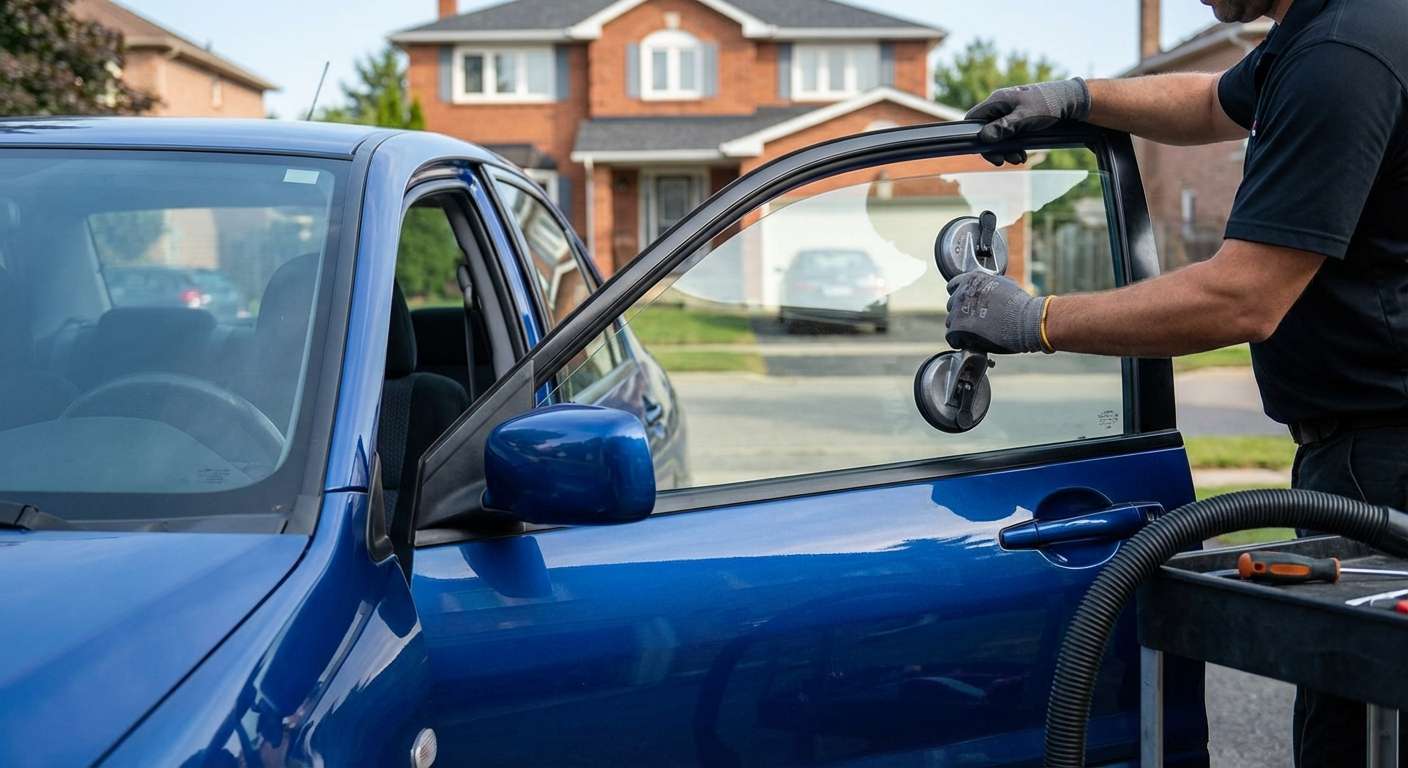
Framed Sash Architecture and Door Glass Dimensions
Replacing the side window on this car requires working around a rigid, fully framed door sash rather than the frameless designs found on some Japanese compacts of the same era. Every trim—ranging from the base ES and LS up through the OZ Rally, the sportier Ralliart, and even the turbocharged Evolution VIII and IX—relies on an integrated rubber run channel that seats directly inside the metal sash frame. While Evo models feature aluminum exterior body panels and distinct flared quarter arches, the side glass geometry itself matches the standard sedan doors.
The front door positions take NAGS part numbers FD21255 on the driver side and FD21256 on the front passenger side. The glass is a standard single-pane green solar-tinted window with no integrated wiring, antenna traces, or acoustic film interlayers. When replacing damaged glass on these doors, I source high-grade aftermarket glass manufactured by Pilkington, FYG, PGW, or XYG, ensuring the thickness and lower edge curvature seat accurately into the factory lifting tracks.
Rear Division Bars and Quarter Glass Placement
The rear passenger doors do not use a single pane of glass. Instead, Mitsubishi split the door opening into two distinct pieces separated by an upright metal division bar sash:
- Roll-down door glass: The primary movable pane corresponds to factory part MR525741 for the left rear door and MR525742 for the right.
- Stationary quarter vent: Fixed inside the rear corner of the door frame, using factory part numbers MR525825 (left) and MR525826 (right).
Because the drop glass travels within the front edge of this vertical division bar, any impact that shatters the main roll-down glass can leave loose tempered fragments jammed inside the division channel. If the division bar is slightly bent during an impact or forced entry, the replacement drop glass will bind before it reaches the top weatherstrip.
| Glass Position | OEM Part Reference | NAGS Identifier | Glass Configuration |
|---|---|---|---|
| Front Driver (LH) | MR525739 | FD21255 | Roll-down pane |
| Front Passenger (RH) | MR525740 | FD21256 | Roll-down pane |
| Rear Left (LH) | MR525741 | FD21257 | Roll-down pane |
| Rear Right (RH) | MR525742 | FD21258 | Roll-down pane |
| Rear Stationary Quarter (LH) | MR525825 | — | Fixed vent glass |
| Rear Stationary Quarter (RH) | MR525826 | — | Fixed vent glass |
Inner Door Shell Hardware and Weather Seals
Servicing the window glass on the CS and CT body styles involves working beneath the interior door card, where an unbroken plastic vapor barrier film seals out cabin drafts. Beneath this shield, the bottom edge of the glass rests on support brackets linked to the window regulator mechanism.
The exterior beltline weatherstrips—specifically MR525755 and MR525756 on the front doors, along with MR525757 and MR525758 across the rear—wipe dirt away from the glass face. Over time, these rubber strips harden and trap road grit. When this grit settles against the glass run channel (part MR526475), it causes the replacement pane to drag or rise unevenly inside the upper sash. Cleaning out this guide channel and clearing broken tempered debris from the bottom well of the door shell ensures the new glass travels smoothly between the front post and the rear sash guide.





