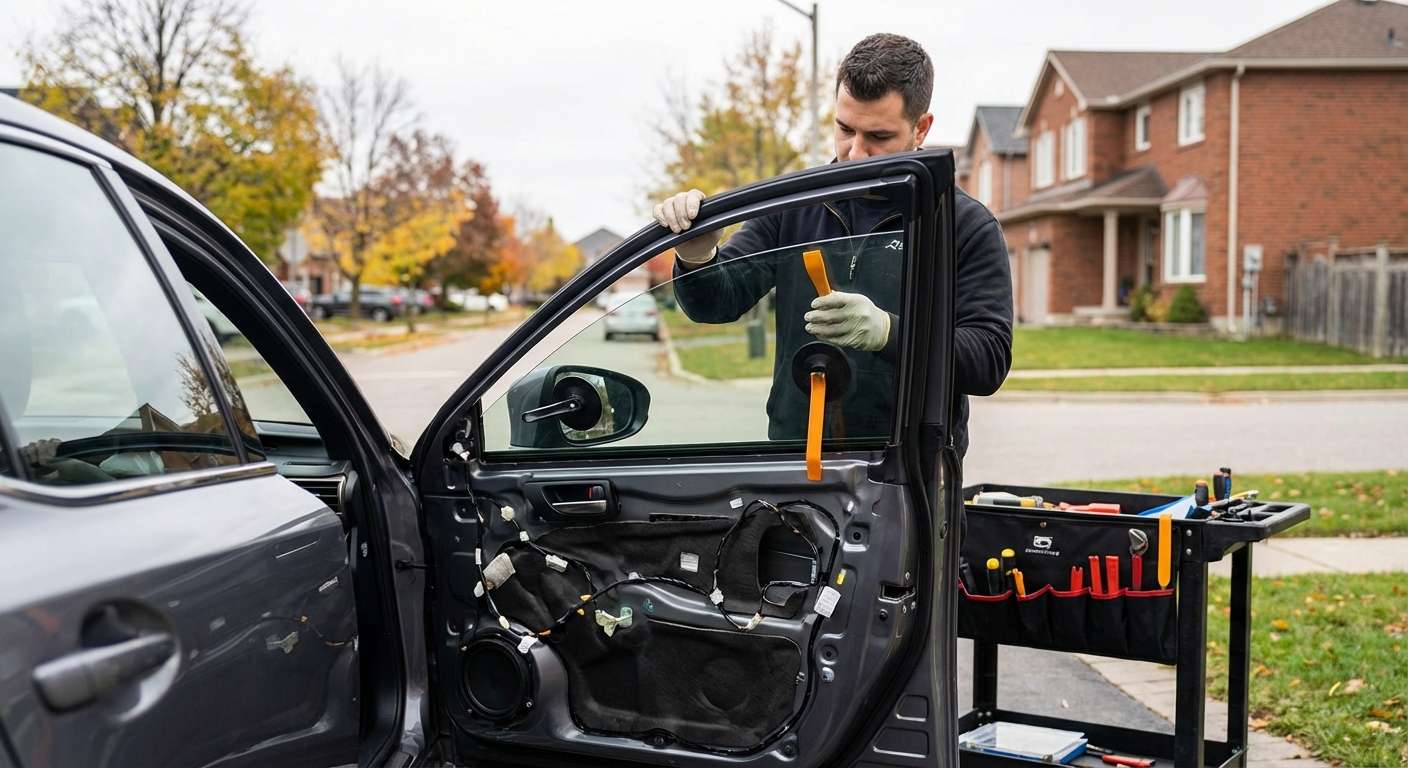
Side Window Characteristics and Channel Friction Issues
The front doors on this sport sedan rely on framed window architecture, avoiding the exposed edges of frameless designs but demanding precise alignment inside the deep rubber run channels (OEM 68141-53040 for the front doors). Factory front glass is tempered green-tinted safety glass, originally produced by AGC under the Temperlite brand or Nippon Safety Glass, carrying solar-absorbing properties that cut down cabin heat soak. The rear passenger glass steps up the infrared and ultraviolet filtration, creating a distinct two-stage solar load profile across the side profile.
Because the framed channel keeps constant contact with the glass edges, stiff weatherstripping in colder weather frequently triggers the vehicle's anti-jam safety reverse. When the glass encounters friction rising past the beltline mouldings, the power window motor interprets the resistance as an obstruction, sending the glass back down halfway. While the dealer inventory lists the front driver side as 68102-53070 and the front passenger side as 68101-53070, I source and fit reliable aftermarket options from major glassmakers like XYG, PGW, Pilkington, and FYG, all of which come equipped with the bonded bottom mounting brackets required to bolt directly to the cable-driven regulator.
Regulator Interface and Rear Division Bar Layout
The side profile construction separates the front drop glass from a split-pane layout on the rear doors. The front door glass uses pre-attached lower brackets that drop down into the door shell to mate with the carrier clamps. In the back, the retractable drop window operates right alongside a fixed stationary quarter glass, separated by a rigid vertical metal division bar. If this division channel is knocked out of true during a break-in, the drop window will bind against the upright channel felt and chatter during travel.
Unlike the windshield or rear backlite, neither the front nor rear door glass houses radio antennas, rain sensors, or heated defroster grids. Power is delivered strictly through a cable-driven regulator fastened with 10 mm hardware behind the inner door vapor barrier. Whenever the door glass is detached or the car's 12V battery is disconnected during repairs, the electronic control module loses its baseline travel limits, disabling the one-touch auto up and down feature on the door master switch until the safety system is manually cycled and relearned.
What to Verify Once the Replacement Glass Is Installed
- One-Touch Auto Up/Down: Pull the switch up until the window completely seats in the top channel and keep holding the switch for three to five seconds; this confirms the pinch-protection circuit is initialized and stops the window from rebounding back down.
- Beltline Moulding Contact: Inspect the inner and outer rubber window sweeps along the bottom of the window frame to make sure the lips lie flat against the pane without folding under or creating gaps for road spray.
- Division Bar Gap: On rear doors, check the clearance along the vertical metal division upright; the drop glass must slide smoothly parallel to the stationary vent window without rubbing the metal flange.
- Cracked-Open Stability: Lower the front window one to two inches and gently push on the top edge; properly secured regulator clamp bolts ensure the pane does not rock fore-and-aft or rattle inside the upper track.
- Run Channel Seating: Make sure the upper perimeter rubber has not pinched or buckled into the upper frame corners, which causes wind hiss at highway speeds.





