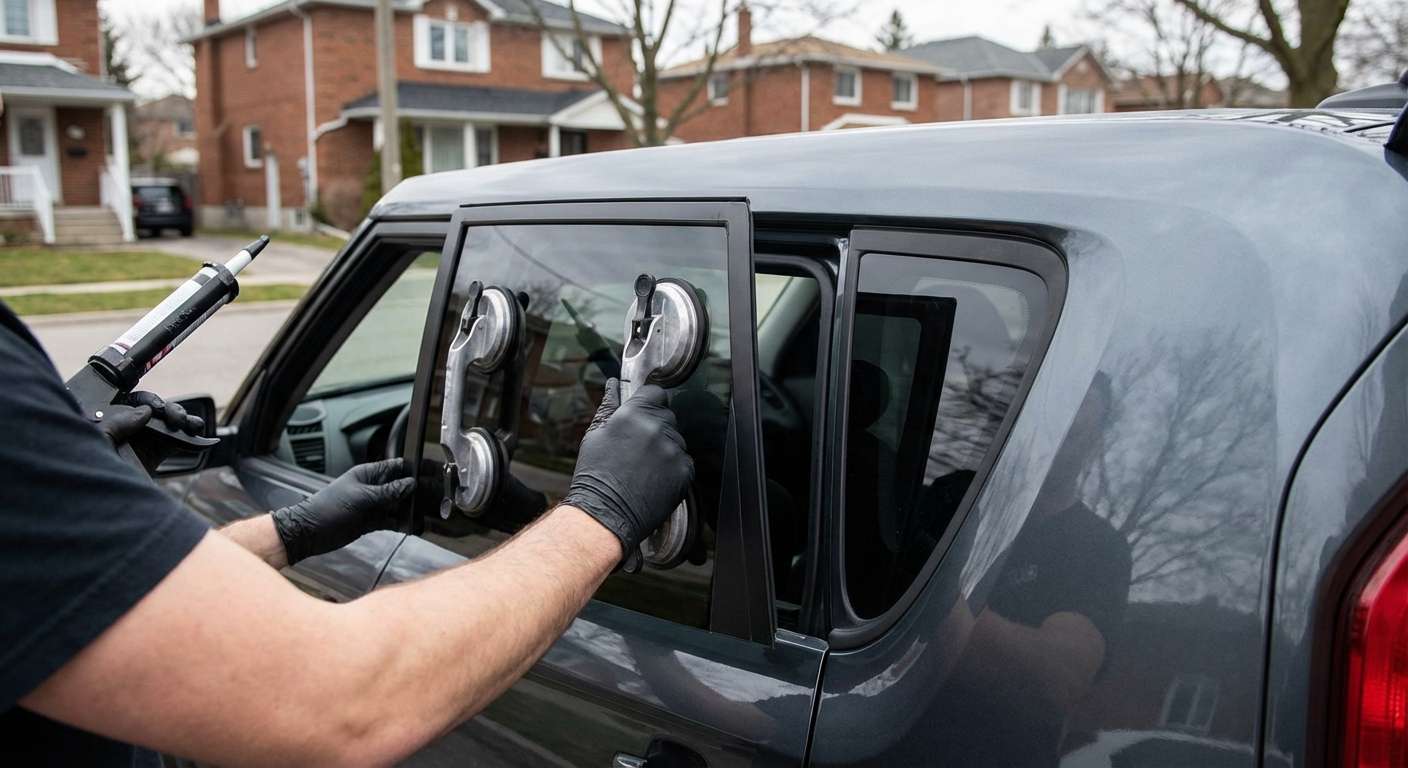
Factory Tint Options and Encapsulated Moldings on Soul Quarter Glass
Replacing the stationary rear side window on this vehicle means dealing directly with the glass tint level, because the factory offered starkly different glass treatments depending on the vehicle package. If you drive a base trim, your vehicle likely left the factory with standard green solar glass, cataloged under NAGS part number FQ25145GTY for the driver side and FQ25144GTY for the passenger side, matching dealer references 87810-2K000 and 87820-2K000. Higher trim packages—specifically the Plus (+), Exclaim (!), and Sport models—feature deep factory privacy tint instead. For those dark glass editions, the aftermarket replacement calls for NAGS part numbers FQ24164YPY on the left side and FQ24163YPY on the right, corresponding to original parts 87810-2K020 and 87820-2K020. Getting this glass match right is critical, as putting a solar green pane on an Exclaim model immediately clashes with the surrounding factory rear door and liftgate tint.
Unlike roll-down door windows, this quarter glass is a fixed, tempered panel manufactured with a pre-attached, encapsulated rubber molding bonded around its outer edge straight from the supplier. Because the rubber gasket is molded permanently to the tempered glass perimeter, it forms the visible exterior transition directly against the body stamping. The glass sits squarely in the rear quarter recess between the C-pillar frame behind the passenger door and the upright D-pillar corner near the rear hatch. Because the glass anchors directly to the body shell rather than inside a door channel, there is no separate exterior division bar or removable exterior trim bezel to unclip.
Interior Access, Rear Quarter Blind Spots, and Service Callouts
When someone breaks this small window to access the cargo latch, the replacement glass must be set cleanly against the painted body aperture, which requires dismantling the plastic interior panels inside the rear cargo bay. The upper interior pillar trim pieces wrap tight around the inner glass perimeter, covering the inner edge of the bonded glass assembly. I pull these rear cargo and quarter pillar trims clear so the glass can sit true against the metal aperture without snagging on the interior plastic moldings.
Because I keep these specific Soul glass variants ready in stock, I can usually be at your location within about an hour of your call to replace the broken quarter panel. Once on site, handling the tall, upright profile of the car requires precision, particularly because the Soul relies on this compact triangular window to break up what would otherwise be a massive blind spot. The thick C-pillar and vertical D-pillar create a wide rear-quarter visual obstruction, making this rear side glass essential for checking traffic before lane changes.
Clean Glass Design Free of Electronics and Wiring
One distinct advantage of this particular quarter window design is the complete absence of secondary electrical hardware. The tempered side glass does not incorporate embedded radio antenna grids, heating defroster wires, or wiring harnesses of any sort. The rear defroster is isolated solely to the back liftgate glass, and the radio antenna mounts on the center roof panel above, leaving the quarter pane completely passive.
There are also no mechanical latch hinges or opening pivot assemblies to transfer over, as seen on older minivans or three-door hatchbacks. While other vehicle recalls like NHTSA 14V822000 affected the headliner bracket near the panoramic roof on certain models of this era, the bonded rear quarter glass remains entirely distinct from roof structure hardware. The aftermarket replacement glass drops in as a fully self-contained unit, consisting solely of the tinted tempered glass panel and its bonded outer perimeter seal.





