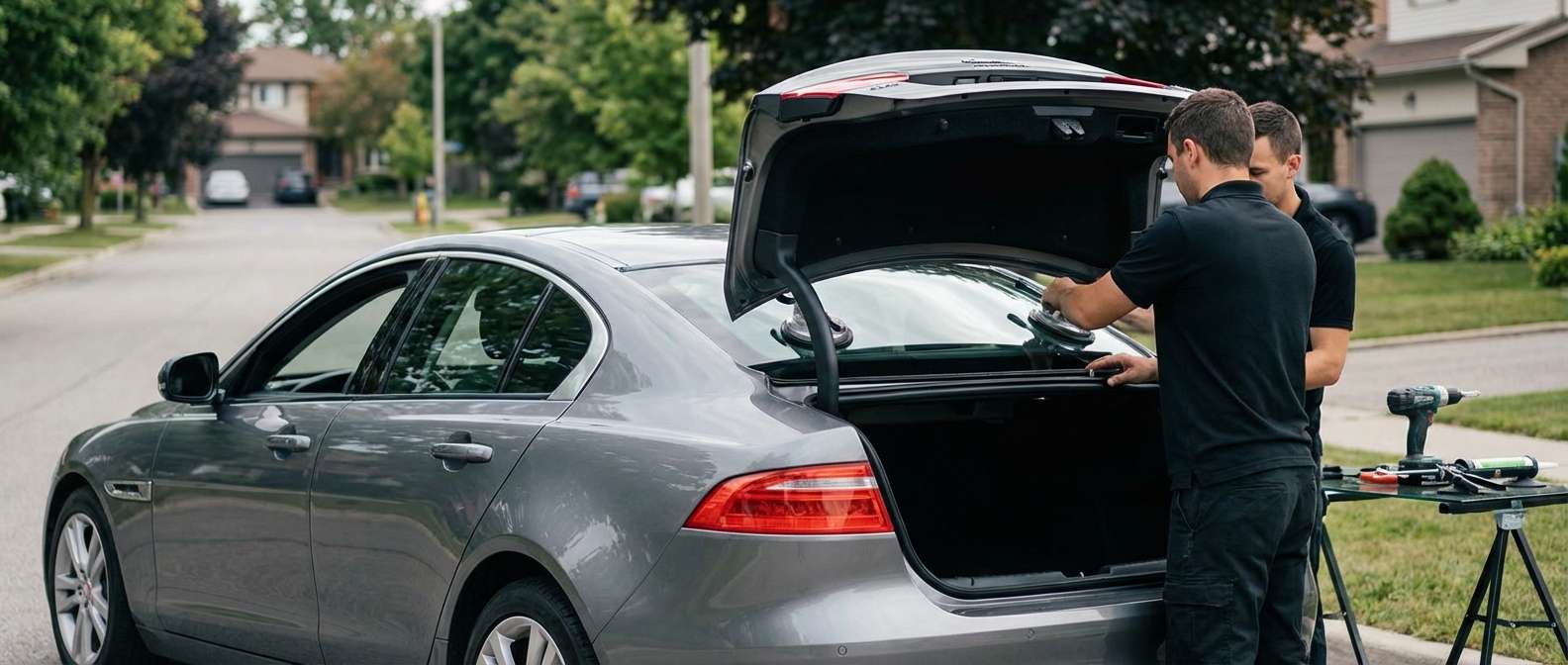
Rear Glass Electronics and Antenna Grid Configuration
Replacing the back window on this sedan involves far more than straightforward glazing because Jaguar embedded two critical electronic networks directly onto the tempered glass face. Across the central field, you have the standard horizontal defroster lines, but the upper rows share physical glass space with the vehicle's AM/FM diversity antenna array. These printed conductive traces terminate at sensitive spade connectors tucked behind the interior C-pillar trim panels. If you have noticed radio static that correlates with turning on your rear demister, the internal trace bridges on the window have likely fractured or peeled.
Because the antenna harness ties directly into the rear glass, the electrical configuration often causes confusion during a replacement. Depending on the audio and telematics tier specified for your car—whether a standard sound package or the higher-output Meridian surround system—the number of active spade leads changes. Some vehicles utilize dual leads on each side of the glass to power both the heating grid and signal amplifiers, while others leave specific factory tabs unpopulated. When I complete this rear window replacement on-site at your home or office anywhere across Toronto and the Greater Toronto Area, I verify each internal harness connection against your car's specific audio build so the diversity module receives a clear radio signal without electrical interference.
Bonding Within the Aluminum X760 Body Structure
The back glass on this model mounts into an aluminum-intensive monocoque structure that requires precise edge positioning. The glass itself comes factory-encapsulated with an integrated perimeter molding, designed to sit flush between the welded aluminum C-pillars and the trunk lid shutline. At the upper edge, the glass borders the roof panel directly beneath the exterior shark fin antenna pod. There is zero margin for vertical misalignment: sitting too high fouls the lower clearance of that roof pod, while sitting too low creates an uneven gap against the rear decklid weatherstripping.
Inside the cabin, the lower edge of the glass drops tightly behind the fixed rear parcel shelf. Unlike an SUV or hatchback, there is no rear wiper motor or fluid washer tubing to route through the glass, keeping the lower perimeter clean. However, the space between the rear headrests, the package tray, and the interior C-pillar moldings leaves very little physical clearance for the wire leads, requiring careful handling so the delicate defroster busbars are not bent during positioning.
| Component / Feature | Jaguar XE Back Glass Specification |
|---|---|
| Industry Part Number | NAGS FB26672 |
| Glass Material | Tempered safety glass with solar/privacy tint |
| Integrated Grids | Electric heating element + AM/FM diversity antenna |
| Body Architecture | Direct-glazed to Jaguar X760 aluminum structure |
| Perimeter Finish | Factory-moulded edge encapsulation |
Trim Variations Across the 2017–2019 Model Run
Whether dealing with an entry-level Base, a mid-range Or Prestige, or a performance-oriented R-Sport, Landmark, or S model, the physical dimensions and structural contour of the rear glass remain identical. Jaguar retained the same stationary, urethane-bonded glass profile across both the four-cylinder Ingenium variants (25t, 20d, 30t) and the supercharged 3.0-litre V6 35t and S editions.
The only operational variance lies in how owners treat the glass surface. A frequent issue with these cars stems from aggressive scraping during aftermarket window tint removal. The printed metallic antenna lines located near the top third of the glass are exceptionally fine; a single razor nick disrupts the continuity of the diversity circuit, knocking out AM reception entirely and degrading weak FM stations. Once these printed lines sever near the edge encapsulation, the defroster and antenna circuits cannot be reliably bridged with conductive paint, making complete replacement of the rear glass unit the only permanent fix.





