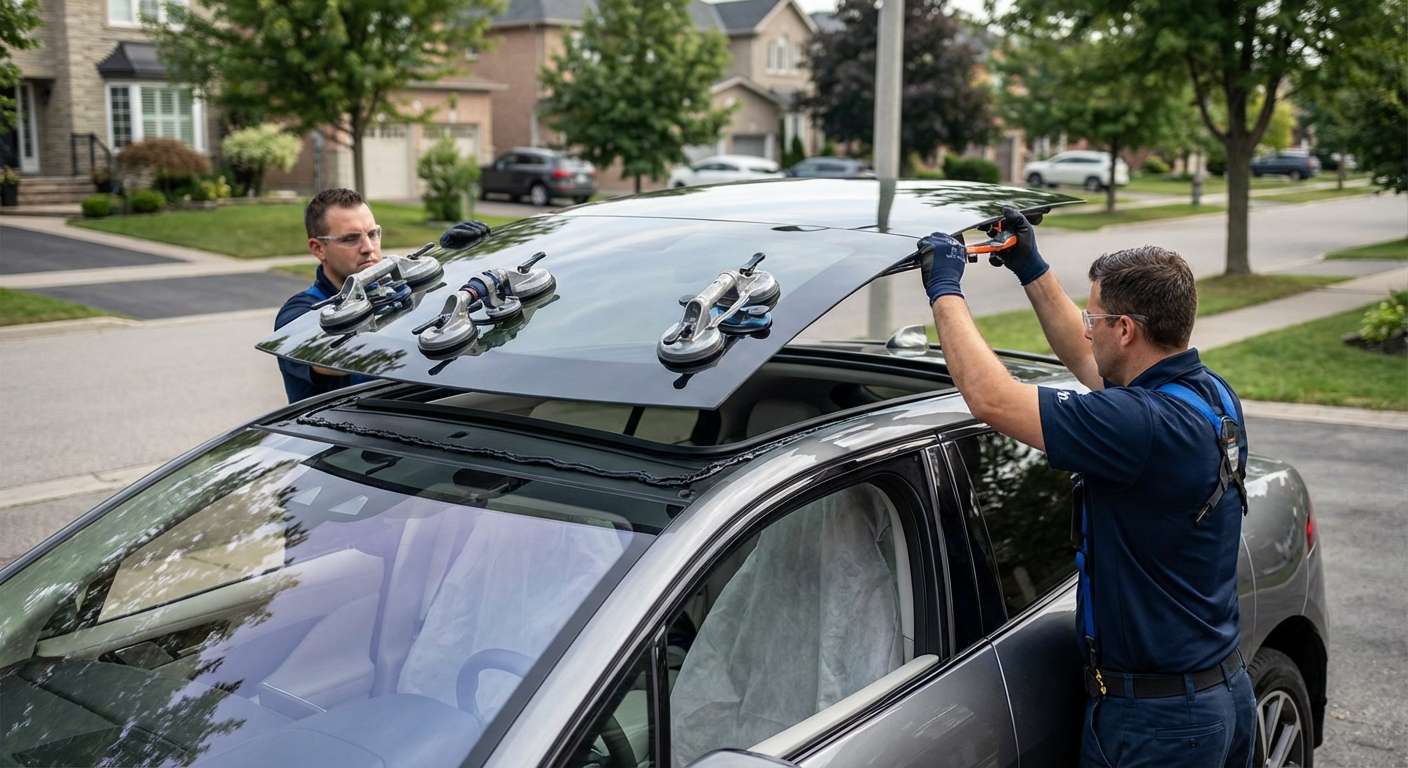
Dealing with Cracks and Cabin Heat on the Fixed Glass Roof
Jaguar opted for an expansive, unbroken sheet of glass above the cabin on this electric crossover, and when a highway pebble strikes near the outer perimeter, that seamless look turns into an immediate stress crack across the roof. Because the panel carries no mechanical tilt or slide hardware, it is purely a fixed panoramic unit bonded straight to the aluminum body frame. The original panel was assigned part number T4K1410 (stamped as J9D3-50054-BA), relying on a deep acoustic laminate paired with an infrared-reflective coating instead of an internal mechanical shade. When I supply and fit a new panel, I source strictly aftermarket glass produced by major manufacturers like Pilkington, PGW, FYG, or XYG to match those critical solar-control and acoustic specs.
On the road, the lack of an integrated roller blind is one of the most persistent complaints among drivers. Jaguar relied entirely on the glass coating to reject radiant heat, leaving owners to either purchase the factory two-piece clip-in fabric screens (part number T4K11558) or seek heavy interior ceramic films. When a fractured panel needs replacement, retaining that infrared rejection is essential; without proper acoustic lamination and solar attenuation, the cabin temperature spikes dramatically and the air conditioning draws excessive power from the high-voltage traction pack.
Structural Ties, Surrounding Trim, and False Leak Diagnoses
Replacing this fixed glass involves navigating tight clearances around the perimeter of the X590 body. The glass sits flush against encapsulated edge molding, butting right up against the top edge of the front windshield and terminating just ahead of the rear telematics antenna pod. Because the forward gap between the roof panel and the windshield is razor-thin, handling the roof glass requires addressing the windshield's top reveal molding to avoid contact damage.
Inside the cabin, the entire molded headliner, overhead console, and the upper trim on the A-pillars and B-pillars encircle the aluminum mounting flange. This design leads to a frequent diagnostic error discussed in owner communities:
- A-Pillar Water Intrusion: Water dripping down the inside of the A-pillar is frequently blamed on panoramic roof seal degradation, yet the fixed roof bond is rarely the culprit. In reality, void spots in the original factory urethane along the upper windshield edge are usually feeding water down into the headliner corners.
- Torsional Stress: Because this giant pane acts as a structural shear plate over the aluminum aperture, driving over angled driveways or uneven terrain places torsional loads across the glass, causing existing stone chips to spread rapidly.
- Absence of Internal Wiring: The roof glass itself is completely passive. You will not find embedded defroster lines, rain sensor brackets, or radio aerials inside this panel, as the GPS and cellular antennas are isolated inside the composite shark fin behind the glass edge.
Can I add an electric sliding shade during replacement?
No. The cabin structure and headliner have zero clearance or wiring harnesses for a motorized blind track. If the overhead heat bothers you, the only workable solutions remain the two-piece OEM clip-in mesh shades or installing an aftermarket ceramic heat-rejection film to the underside of the laminated glass.
Does a rock chip mean the whole roof must be swapped out?
Minor surface chips in the center of the panel can sometimes be stabilized if caught early, but cracks that run to the encapsulated edge compromise the panel's structural integrity. Because the glass stiffens the vehicle's aluminum roof frame, edge cracks will continue to run across the entire length of the cabin under everyday body flex, requiring a complete panel renewal.





