Overhead Glass Fractures and Track Stresses on the Audi e-tron
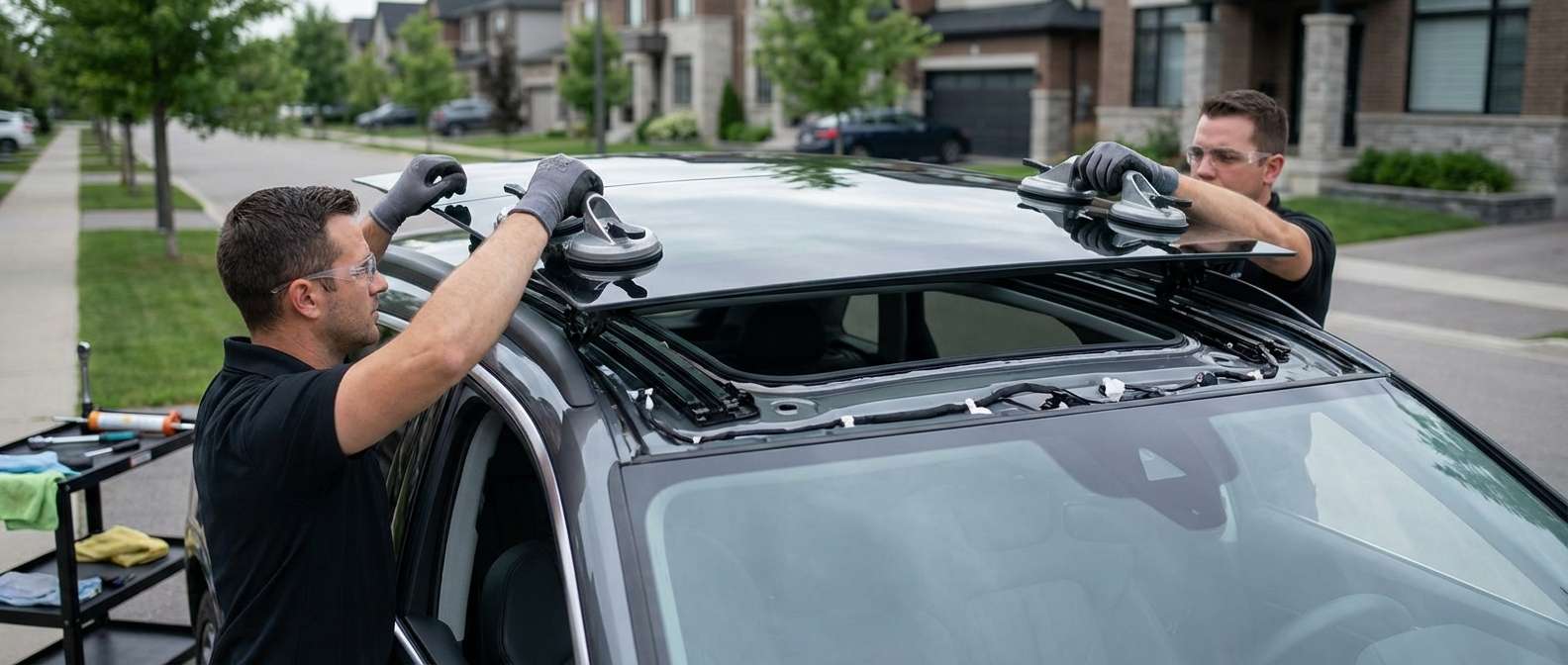
Direct rock strikes to the leading edge of the front sliding glass panel cause the vast majority of panoramic sunroof failures on this electric SUV. Because the front tilt/slide glass extends nearly flush with the roofline just past the windshield header, highway debris frequently bypasses the front glass and impacts the tempered sunroof panel instead. When struck, the factory panel shatters completely into small pebble fragments, instantly dropping debris onto the fabric roller sunblind beneath it. Mechanical binding inside the composite-and-aluminum guide frame also creates sharp localized torsion; if the drive cables bind while pulling the front carriage, the uneven torque can crack the movable panel under heavy flex.
Hardware Architecture of the 4M8 Panoramic Assembly
The roof cassette on this model relies on a dual-pane setup consisting of an operational forward panel and a stationary rear lite. Audi services the front movable pane under part number 4M8-877-055 (superseded by 4M8-898-055-B), while the rear fixed glass is listed under 4M8-877-056. Both panels mount directly onto a unified roof carrier that bolts to the vehicle's structural roof header and outer arches, a layout shared directly with the MLB Evo platform sibling Audi Q8. Surrounding hardware includes an automated spring-loaded mesh wind deflector at the front aperture, pre-fitted outer edge seals (part 4M8-877-297), and four corner drain channels running down the A-pillars and C/D-pillars.
| Component | OEM Reference | Function / Placement |
|---|---|---|
| Front Movable Glass | 4M8-898-055-B | Tilt-and-slide tempered panel driven by side cable carriages |
| Rear Fixed Glass | 4M8-877-056 | Stationary panoramic panel positioned over rear passenger row |
| Perimeter Seal | 4M8-877-297 | Surrounds outer cassette boundary to suppress cabin wind noise |
| Mesh Deflector | Cassette Integrated | Spring-actuated pop-up barrier deployed on open track position |
Whenever I handle replacement panels for this vehicle, I work strictly with aftermarket glass sourced from major automotive manufacturers like Pilkington, PGW, FYG, or XYG rather than dealership-supplied units. These aftermarket assemblies match the original perimeter encapsulation and thermal solar-tint depth required to keep the high-voltage cabin cooled efficiently.
Addressing Frame Drainage and Seal Displacement
Water intrusion inside the cabin is frequently traced back to problems surrounding the sunroof structure rather than panel cracks alone. Audi documented this in Technical Service Bulletin TSB 2063187, addressing perimeter seal separation along the outer carrier that causes intense wind buffeting at highway speeds. Furthermore, the four internal drain tubes that exit behind the wheel arches and rocker panels can easily kink or clog. When fine grit builds up in the forward A-pillar lines, water overflows the cassette catch basin, spilling into the front overhead console and tracking down into the floor footwells, where critical wiring harnesses reside.
Replacing the front sliding pane also involves re-synchronizing the motor end limits. Because the panel connects to an anti-pinch safety mechanism, the drive motor must be adapted using Audi ODIS diagnostic software so the carriage registers the exact closed stop point without stressing the newly seated glass.
Can the front movable glass panel be replaced without disturbing the rear fixed glass?
Yes. The forward tilt/slide glass operates on independent side carriage guides and can be unbolted from its mechanical track brackets without unseating or removing the rear stationary pane.
Why is there wind rush over the sunroof even when the glass is fully shut?
This is typically caused by outer edge seal shrinkage or detachment, as outlined in Audi TSB 2063187. If the seal pulls away from the roof channel, air forces past the glass perimeter and resonates against the deflector housing.
Do the roof panels contain rain sensors or aerial connections?
No. The rain and light sensors are mounted on the windshield behind the rearview mirror, while radio and navigation antennas are housed in the rear shark-fin module behind the glass frame.