Direct Bonding to the Carbon-Fiber Monocoque
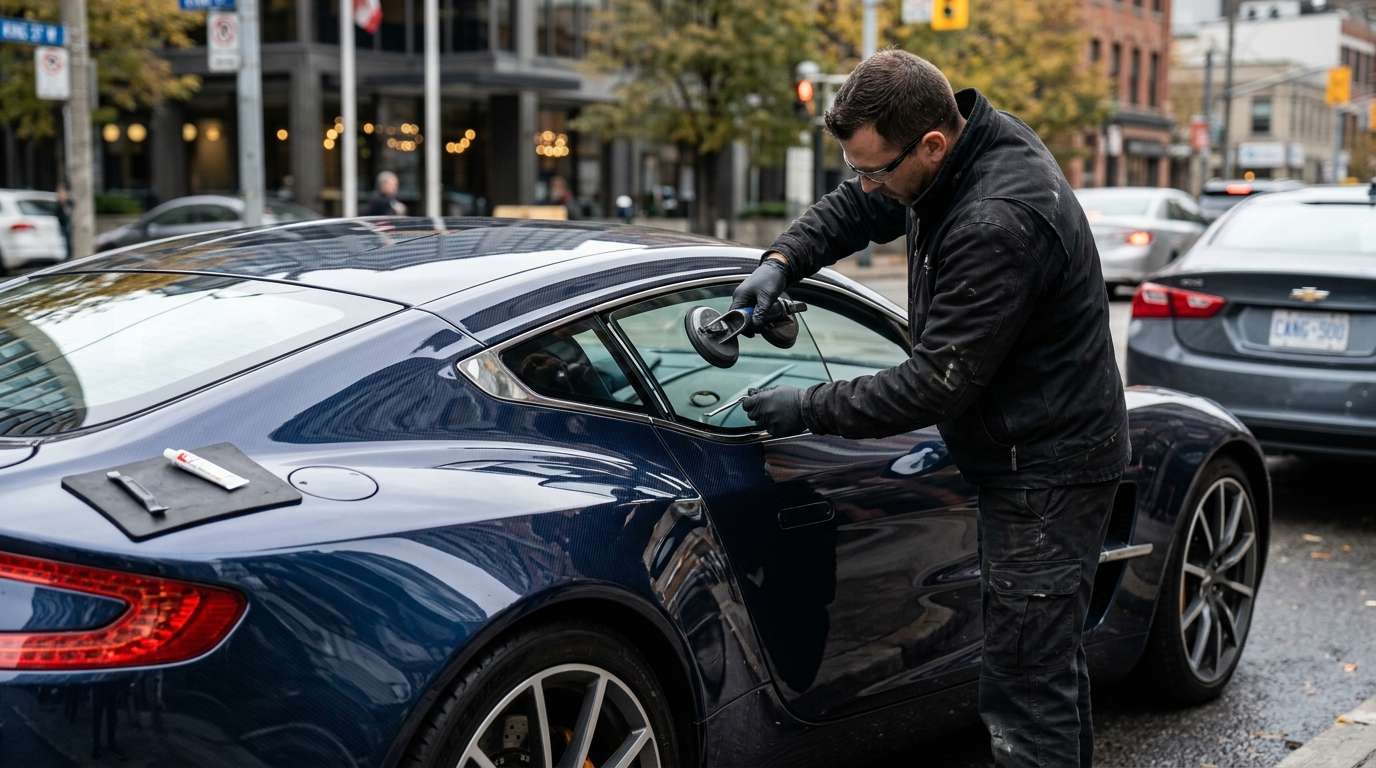
Replacing the stationary rear quarter glass on this hypercar demands an exact understanding of its composite tub architecture. Unlike conventional vehicles that use stamped steel pinchwelds, the quarter window seats straight against the structural carbon-fiber monocoque, meeting hand-formed aluminum rear fender panels toward the aft edge. Because the car lacks standard automated production lines, each aperture carries minute variations shaped by hand-finishing at the Gaydon facility.
The glass itself is completely passive, devoid of heating grids, embedded aerials, or mechanical lifters. However, its positioning governs the acoustic boundary of the cabin. When I handle this installation, I back the glass with a one-year material guarantee alongside a lifetime promise covering the integrity of my workmanship. The glass panel sits immediately adjacent to the interior's bespoke carbon and leather bodyside trim, running forward to meet the vertical division pillar that anchors the exterior weatherstripping.
Division Bar Tolerances and Swan-Wing Door Seals
The forward border of the quarter glass connects with a dedicated division bar assembly. This vertical post does more than just frame the quarter window; it establishes the primary shut face for the frameless swan-wing doors. When the doors sweep outward and upward at their signature 12-degree angle, the sealing pressures release completely. When pulled shut, the frameless door glass compresses against the division bar weatherstrip.
If the quarter window is misaligned with the division bar by even a millimeter, wind noise penetrates the cabin behind the front seats, directly disturbing the cabin space where each vehicle's numbered One-77 plaque is mounted to the inner trim. Proper orientation relative to the division structure ensures uniform compression along the entire perimeter seal.
| Component Description | Left-Hand (LH) Reference | Right-Hand (RH) Reference |
|---|---|---|
| Fixed Quarter Glass Panel | 12023-05-1056-AB | 12023-05-1057-AB |
| Quarter Division Bar Assembly | DBY00389-A | DBY00390-A |
| Structural Bonding Substrate | Carbon-Fiber Tub | Carbon-Fiber Tub |
| Adjoining Exterior Bodywork | Hand-Beaten Aluminum | Hand-Beaten Aluminum |
Factory Component Architecture and Sourcing Realities
Because the production run was capped at 77 units globally, standardized glass catalogs have no listing for this vehicle. NAGS (National Auto Glass Specifications) numbers do not exist for the quarter windows. Every individual pane follows factory part numbers 12023-05-1056-AB for the left side and 12023-05-1057-AB for the right side, paired with division pillars DBY00389-A and DBY00390-A respectively.
Replacing one of these units involves working around several vehicle-specific elements:
- Monocoque Contact Margin: The direct carbon-to-glass interface requires an exact depth profile so the outer face sits flush with the rear aluminum quarter panel.
- Division Bar Sealing: The joint between the fixed glass and the door division pillar dictates how cleanly the door window mates with the body at highway speeds.
- Internal Cabin Clearance: The glass sits fractions of an inch away from the rear interior composite panels and the commemorative numbered identification plate.
- Non-Regulated Design: The window remains fully fixed, relying entirely on surrounding exterior moldings rather than movable tracks or perimeter mechanical clips.