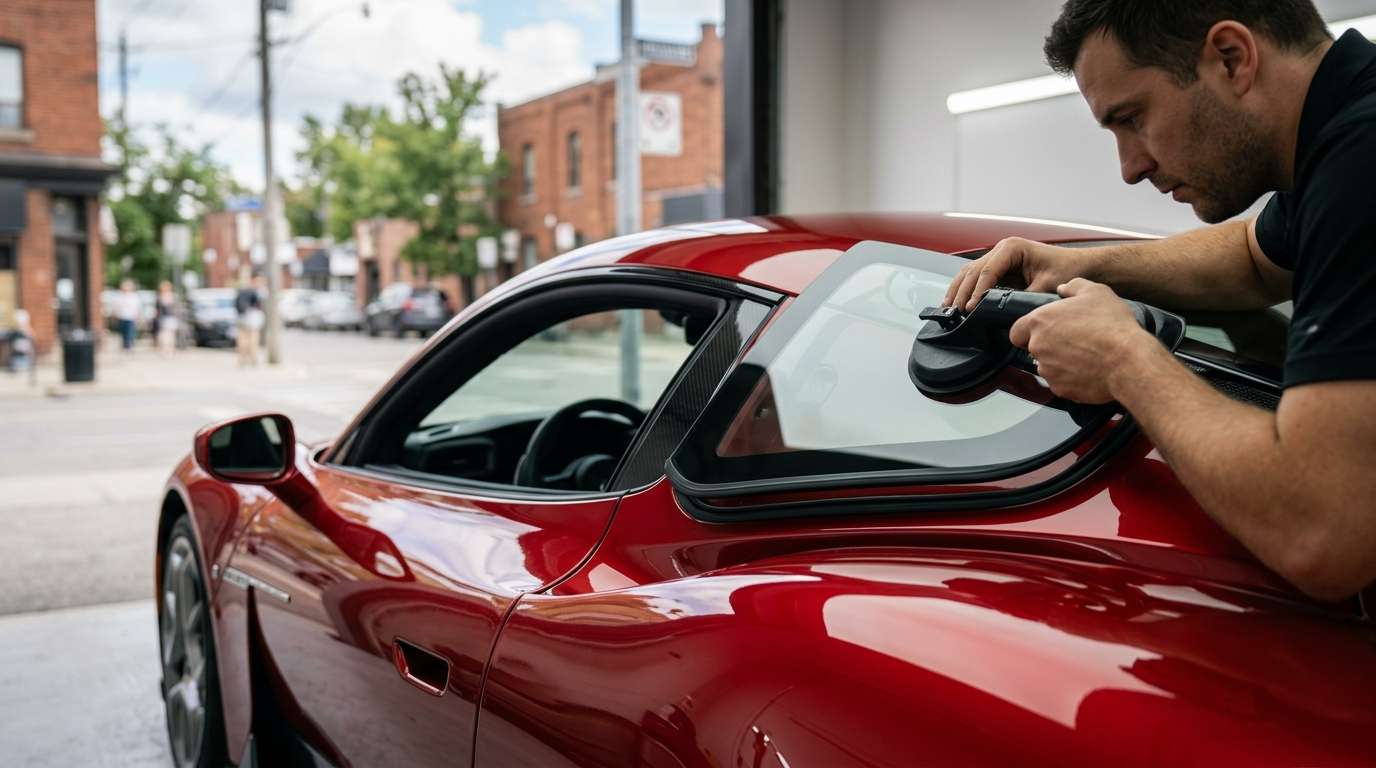
The Curved Butterfly Canopy Architecture
Working on the side glazing of this car reveals immediately that it does not use a traditional fixed quarter window set into a metal C-pillar. Instead, Carrozzeria Touring Superleggera engineered panoramic butterfly door glass that sweeps straight up into the roof structure, meeting a central structural spine. The trailing edge of this glass does not terminate at a painted body quarter panel; it seats directly against the forward shutline of the massive rear clamshell, known as the cofango, which routes high-pressure air directly into the side intercooler intakes. Because the adjacent rear engine cover is formed from molded polycarbonate rather than glass, the canopy side sections are the most complex transparent structural pieces on the car's flanks.
Every piece of glazing is paired to bespoke structural carbon-fiber window frames designed to mesh with the hybrid carbon-fiber monocoque and aluminum roof cage. When replacing side glass on high-value machinery across Toronto and the GTA, I travel directly to the client's private garage or workplace so the vehicle never has to sit unprotected on an open transport truck. Whether an owner selected the Tributo cabin appointments or the track-oriented Alfa Corse configuration, the bespoke Bottega Fuoriserie perimeter trim around the canopy glass requires absolute alignment precision against the carbon-fiber door sash before the assembly is secured.
Pre-Installation Glass Inspection Points
Because there is no NAGS standard database listing or high-volume factory catalog for a hand-built run capped at 33 customer vehicles, every replacement canopy glass panel must be scrutinized individually prior to placement. I check the curvature profile across three distinct zones: the vertical door drop, the compound roll into the roof, and the trailing rear edge that aligns with the cofango body gap.
| Inspection Zone | Component Interface | Critical Tolerance Point |
|---|---|---|
| Roof Arc | Aluminum Roof Cage Spine | Continuous profile sweep without high spots |
| Door Frame | Structural Carbon-Fiber Sash | Even seating along the full interior bonding channel |
| Rear Edge | Clamshell (Cofango) Air Intake Line | Parallel panel gap matching the rear body line |
The glass must be completely free of optical distortion through the severe upper radius where the pane turns horizontal. Because the forward safety cameras and environmental rain sensors are contained entirely up on the front windshield, this side canopy glass features no embedded sensor brackets, defroster lines, or radio aerial filaments. The focus remains purely on structural symmetry, flawless edge finishing, and uniform thickness across the frameless contact edges.
Post-Installation Fitment and Seal Verification
Once the glass is set into the door assembly, the mechanical dynamic of the butterfly hinge completely dictates the fit. The hinge system carries the entire curved canopy upward and forward simultaneously. If the glass sits even half a millimeter off within its carbon surround, the frameless glass edge will foul the roof cage or pinch the perimeter rubber.
- Confirm that the upper curved margin clears the central aluminum roof spine as the butterfly door swings fully forward into its open detent.
- Inspect the seal compression along the top edge, ensuring the glass seats flat against the roof micro-gaskets without rolling the rubber lips.
- Verify an exact, parallel panel gap between the trailing glass edge and the leading edge of the rear clamshell intake duct.
- Examine the bond line against the interior carbon-fiber window frame to ensure no adhesive extrusion creeps past the Bottega Fuoriserie leather or Alcantara border trims.
- Check the flush exterior alignment where the bottom of the glass transitions into the lower carbon door skin to prevent wind buffeting at highway speeds.





